
What Really Happened When Germany Schaefer Ran Back to First
The documented play came in 1911: Schaefer retreated from second to revive a scoring chance; the famous 1908 Detroit story remains unverified.
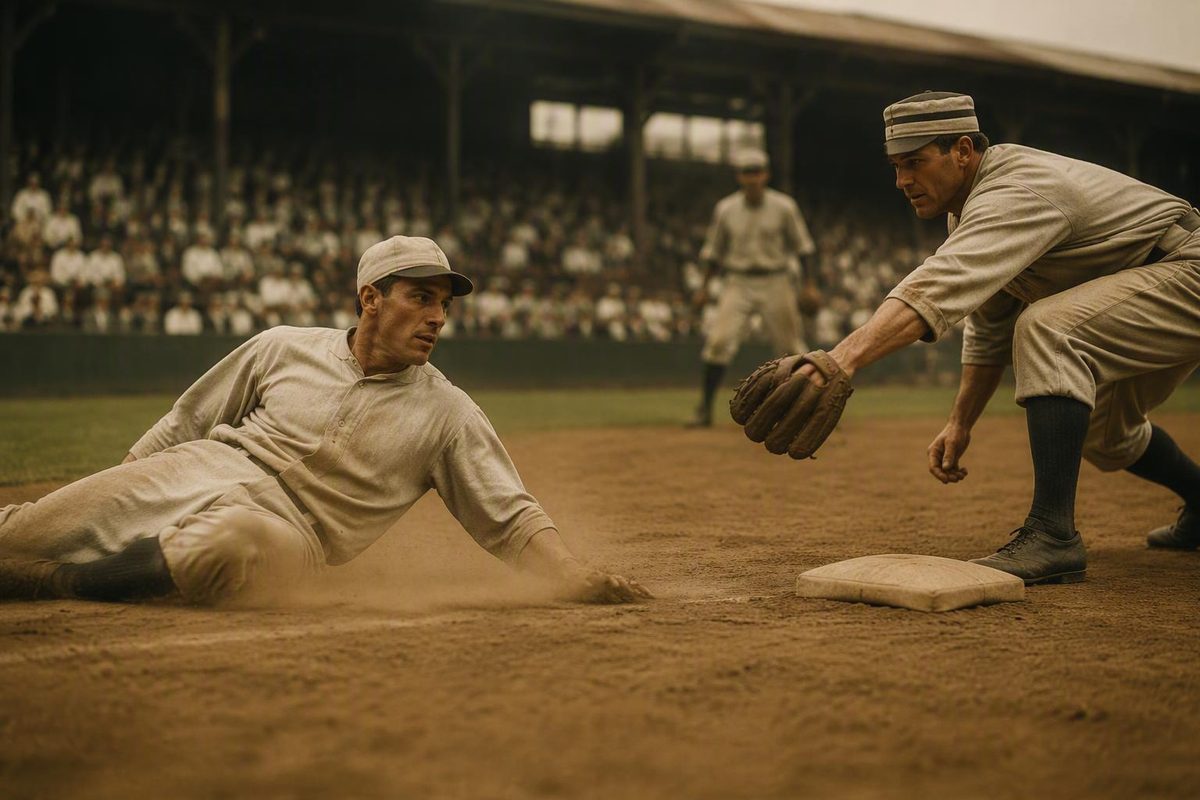
Germany Schaefer’s famous “steal of first base” was a deliberate retreat from second toward first, not a batter advancing from home plate. The strongest historical record places the play on August 4, 1911, when Schaefer’s Washington club faced the Chicago White Sox. The better-known story that he successfully used the tactic for Detroit against Cleveland in 1908 remains unverified according to the Society for American Baseball Research’s Schaefer biography.
The verdict: Schaefer’s documented “steal” happened in 1911
In the documented Washington play, Schaefer ran backward from second toward first so he could make another dash for second. His objective was to induce a throw or rundown that would give Clyde Milan an opportunity to score from third.
“Stealing first” is therefore memorable but technically misleading. Schaefer did not leave the batter’s box and steal an unoccupied first base. He had already reached first, advanced to second, and then reversed direction toward a base he had passed.
The historical footing for this version is considerably stronger than for the supposed Detroit episode. Secondary accounts attribute next-day reports of the Washington play to both the Washington Post and the Chicago Tribune. Those accounts identify Washington and Chicago as the teams and describe Milan being retired at home during the resulting play.
Schaefer was a longtime major-league infielder, but his reputation extended beyond routine hitting and fielding. He became especially well known for showmanship, comic timing, and a willingness to test baseball’s conventions. Those qualities help explain how an unsuccessful baserunning maneuver became the centerpiece of his legend.
How the 1911 play unfolded
The ninth-inning situation and its outcome can be reconstructed as follows from the contemporary reporting summarized in a detailed historical account of the game:
- Schaefer reached first on a bunt. Clyde Milan stood on third as the potential winning run in a scoreless game.
- Schaefer stole second. White Sox catcher Fred Payne declined to throw, denying Milan the opportunity to break for home while the ball traveled to second.
- Schaefer retreated toward first. By returning to the previous base, he attempted to recreate the original first-and-third situation.
- Schaefer headed for second again. His renewed advance produced the defensive action he had wanted and led to a rundown.
- Milan broke for home. Chicago retired him there, ending the inning.
The essential geometry was:
Milan: 3B | Schaefer: 1B → 2B → 1B → toward 2B | intended result: throw/rundown → Milan tries home
The idea was not merely to bewilder the defense. Once Schaefer stood on second and Milan remained on third, Chicago could hold the ball and leave both runners in place. By moving back toward first, Schaefer sought another opportunity to run for second and force the defense to choose: concede the base again or make a play that might leave home vulnerable.
The tactic failed. Milan was put out at home, so the maneuver did not produce a run or decide the game. Washington eventually won 1–0 in the eleventh inning, with Walter Johnson credited with the victory. The reported scoring gave Schaefer one stolen base for the sequence, not a second stolen base for his reverse movement.
Why the famous 1908 Detroit story remains unverified
The folklore usually begins three years earlier. In a later recollection, former Detroit outfielder Davy Jones described Schaefer trying the tactic while playing for the Tigers. Jones remembered being on third while Schaefer advanced from first to second. When Cleveland catcher Nig Clarke held the ball, Schaefer returned toward first and then tried for second again. In that telling, the renewed attempt finally drew a throw and allowed Jones to score.
Retellings commonly assign the incident to September 4, 1908, against Cleveland. The schedule creates an immediate conflict: Detroit played St. Louis that day, not Cleveland. Detroit had faced Cleveland from August 30 through September 3, but a review of that series found no game matching the remembered participants and stolen-base details. The same review found no confirming contemporary newspaper report in its comparison of the 1908 story and the documented 1911 play.
That discrepancy does not conclusively prove that Jones invented the story or that Schaefer never tried something similar for Detroit. Memories can preserve the outline of a real event while losing its date, opponent, inning, or personnel. But without a matching game or contemporary report, the Detroit account cannot carry the same evidentiary weight as the Washington play.
| Account | Evidence status |
|---|---|
| 1911 | Supported by attributed next-day newspaper coverage |
| 1908 | Based on a later recollection, with a conflicting schedule detail and no matching contemporary report found |
The responsible verdict is unverified, not definitively false. The durable Detroit tale may reflect an uncertain memory of another incident, but the securely dated Schaefer play occurred for Washington against Chicago.
Was running backward legal in 1911?
The rules then in force apparently did not expressly prohibit a runner from deliberately reversing the usual order of the bases. That gap allowed Schaefer to attempt the maneuver.
White Sox manager Hugh Duffy nevertheless came onto the field to protest, showing that the tactic was controversial even if the rulebook did not clearly forbid it. SABR reports that umpire Tommy Connolly said after the game that Schaefer had the right under the existing rules to return from second toward first in its account of the disputed play.
That ruling should not be stretched beyond the evidence. The later historical reconstruction interprets the contemporary rule governing acquired bases to mean that Schaefer remained legally entitled to second after reaching it. On that reading, Connolly tolerated the physical retreat without treating first as though it had become Schaefer’s newly acquired base again.
Permission to move backward also did not make the retreat a conventional stolen base. An ordinary steal records a successful advance under the scoring rules. Schaefer moved in the opposite direction to reset a tactical opportunity, and the scorer reportedly credited only one stolen base for the entire sequence.
The loophole closed in 1920
Baseball adopted an explicit reverse-running prohibition in 1920, the year after Schaefer’s death. In plain language, the rule directs an umpire to call time and declare a runner out when that runner reverses the base order to confuse the defense or make a travesty of the game.
Rule numbering changed as the rulebook was reorganized. The historical reconstruction identifies the older provision as Rule 7.08(i), while the equivalent modern prohibition is Rule 5.09(b)(10) in the current historical summary of Schaefer’s case. The modern number should not be projected backward onto the rulebook adopted in 1920.
Schaefer’s fame has encouraged a simple cause-and-effect story: he ran back to first, so baseball wrote a rule against it. The chronology is less tidy. His Washington play was a prominent example of the loophole, but other runners reportedly had attempted similar maneuvers before him. The evidence does not establish that Schaefer alone caused the rule change; it is safer to say that his stunt illustrated the type of conduct the prohibition addressed.
Schaefer did not invent the idea
Reported examples of reverse-order baserunning predate Schaefer’s documented attempt. The Harry Davis and Fred Tenney incidents are described in Baseball History Blog’s later historical reconstruction and should be treated as reported precedents rather than independently confirmed primary-source findings.
| Date | Runner | Maneuver | Outcome |
|---|---|---|---|
| August 13, 1902 | Harry Davis, Philadelphia Athletics | Returned from second to first, then ran for second again | A rundown helped Dave Fultz score; Davis reached second |
| July 31, 1908 | Fred Tenney, New York Giants | Returned from second to first, then advanced again | Tenney reached second, but the runner on third did not score |
| August 4, 1911 | Germany Schaefer, Washington | Retreated from second, then renewed his run toward second | Clyde Milan tried for home and was retired |
| 1920 | Rule change | Reverse-order running to confuse the defense or make a travesty of the game prohibited | Runner to be declared out |
The reported Davis play shows the tactic working as intended: reverse the sequence, induce a defensive play, and create an opening for the runner at third. Tenney reportedly repeated the maneuver without producing a run. Schaefer later tried it in the documented Washington game, where Chicago retired Milan at home.
Those precedents rule out calling Schaefer the unquestioned inventor. They also weaken the claim that his stunt alone caused the prohibition adopted in 1920. What Schaefer supplied was not necessarily the first use of the idea, but the episode that survived most vividly in baseball’s folklore.
His enduring place in baseball history therefore rests on a documented 1911 attempt to exploit a rules gap, not on a securely established 1908 triumph. The maneuver failed on the field but endured in memory because it captured the inventive possibilities—and interpretive limits—of the game’s early rulebook.
Was Germany Schaefer officially credited with stealing first base?
No. The official scorer reportedly credited Schaefer with one stolen base for the sequence. His backward movement was not recorded as an additional steal of first. “Stealing first” is a colorful name for the maneuver, not a separate official scoring credit.
Could an MLB runner legally run backward to first today?
Not for Schaefer’s tactical purpose. Under modern Rule 5.09(b)(10), an umpire calls time and declares out a runner who reverses the base order to confuse the defense or make a travesty of the game under the modern provision summarized here.
Was Schaefer’s play the same as the Atlantic League’s 2019 “steal of first”?
No. Schaefer retreated from second toward first after he was already a baserunner. The Atlantic League’s 2019 experiment allowed a batter to advance from home to first on certain pitches the catcher did not catch cleanly, extending the opportunity beyond the conventional dropped-third-strike situation. Tony Thomas used the experimental rule on July 13, 2019, in a play scored as a fielder’s choice under the Atlantic League experiment. The plays shared a nickname, but their direction, starting point, and rule mechanics were different.